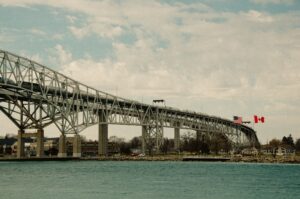
Powerful, vast and irreplaceable, the Great Lakes have sustained life since First Nations first made their homes along these shores.
Together, they form the largest interconnected freshwater system on Earth, providing drinking water to more than 40 million people and sustaining the communities, industries and economies of eight states and two provinces.
They are also the heart of one of the world’s most integrated and consequential economic regions.
Today, that relationship is being tested.
On August 22, the United States imposed a 50 per cent tariff on $27.6 billion in Canadian goods. Canada has responded with matching counter-tariffs on $27.6 billion in U.S. imports, taking effect September 8 and affecting products ranging from steel and aluminum to dairy, agricultural equipment, plastics, electronics, and pulp and paper.
The full consequences of these measures will unfold over time. But one enduring reality is already clear: Canada and the United States cannot separate their prosperity without weakening both.
Nowhere is that truth more visible, or more consequential, than in the Great Lakes region.
“The Great Lakes are more than a border between two nations, they are the lifeblood of a shared region. Tariffs and politics may change, but our waters, economies and communities will remain interconnected. Our strongest path forward is collaboration: protecting what connects us and strengthening what sustains us for generations to come.”
— Vance Badawey, President & CEO, Council of the Great Lakes Region

A Border That Connects More Than It Divides
The Great Lakes are more than a geographic boundary between Canada and the United States. They are a shared freshwater system, an economic engine and a vital transportation corridor connecting communities, industries and markets across the continent.
Every day, manufacturers, farmers and businesses depend on cross-border supply chains, reliable infrastructure and commercial relationships built over generations. The Great Lakes–St. Lawrence Seaway is the backbone of this deeply integrated economy, moving essential goods, supporting jobs and connecting communities across Canada and the United States.
As tariffs alter the cost and movement of goods, businesses may reconsider supply chains, transportation routes, sourcing and investment decisions. Although the full impacts will take time to emerge, the immediate priority must be to preserve the cross-border commercial and institutional relationships that protect businesses, workers and communities from unnecessary disruption.
Building a More Resilient Region
Periods of uncertainty demand practical cooperation. Canada and the United States must work together to strengthen the resilience and security of strategic North American industries while advancing the transportation, border, energy and digital infrastructure upon which our shared economy depends.
That means mobilizing public and private investment in projects of regional significance, reducing regulatory and non-tariff barriers, and connecting innovation, commercialization and workforce development more directly to industrial needs.
These efforts are not solely about responding to today’s trade environment. They are about building a more competitive, secure and resilient Great Lakes economy for the future.
A Shared Resource, A Shared Responsibility
The prosperity of the Great Lakes region ultimately depends on the health of the waters that sustain it.
More than 40 million people rely on the Great Lakes for drinking water, while communities and ecosystems throughout the basin face pressures from plastic pollution, climate change, invasive species, nutrient runoff and aging infrastructure. These challenges do not stop at the international border, and neither can our response.
At the Council of the Great Lakes Region, we recognize that freshwater stewardship and economic prosperity are not competing priorities. Healthy waters, modern infrastructure, innovative industries, skilled workers and strong cross-border relationships are all essential to the long-term success of the region.
Protecting What Connects Us
Trade policies will evolve. Tariffs will come and go. Economic conditions will change. But the Great Lakes will endure, crossing borders, sustaining communities, supporting ecosystems and powering one of the world’s most important economic regions.
Our responsibility is clear: protect the waters that sustain us, preserve the relationships that unite us, and build the infrastructure, industries and workforce that will carry this region forward.
In a time of uncertainty, division is not a strategy. Collaboration is our greatest strength.
The Great Lakes need a strong, united voice, and leadership prepared to act. CGLR continues to work alongside governments, economic development organizations, ports, transportation and logistics providers, manufacturers, investors, chambers of commerce, labour and regional leaders to advance our shared priorities: trade and investment, critical minerals, supply-chain resilience, advanced manufacturing, energy, workforce development and infrastructure modernization. Together, we must lead by example and speak with one voice for the Great Lakes region.
Join us in protecting what connects us and strengthening what sustains us.